Structural shift: how Escape Technology helped Hayes Davidson rebuild from the ground up
.svg)

.avif)

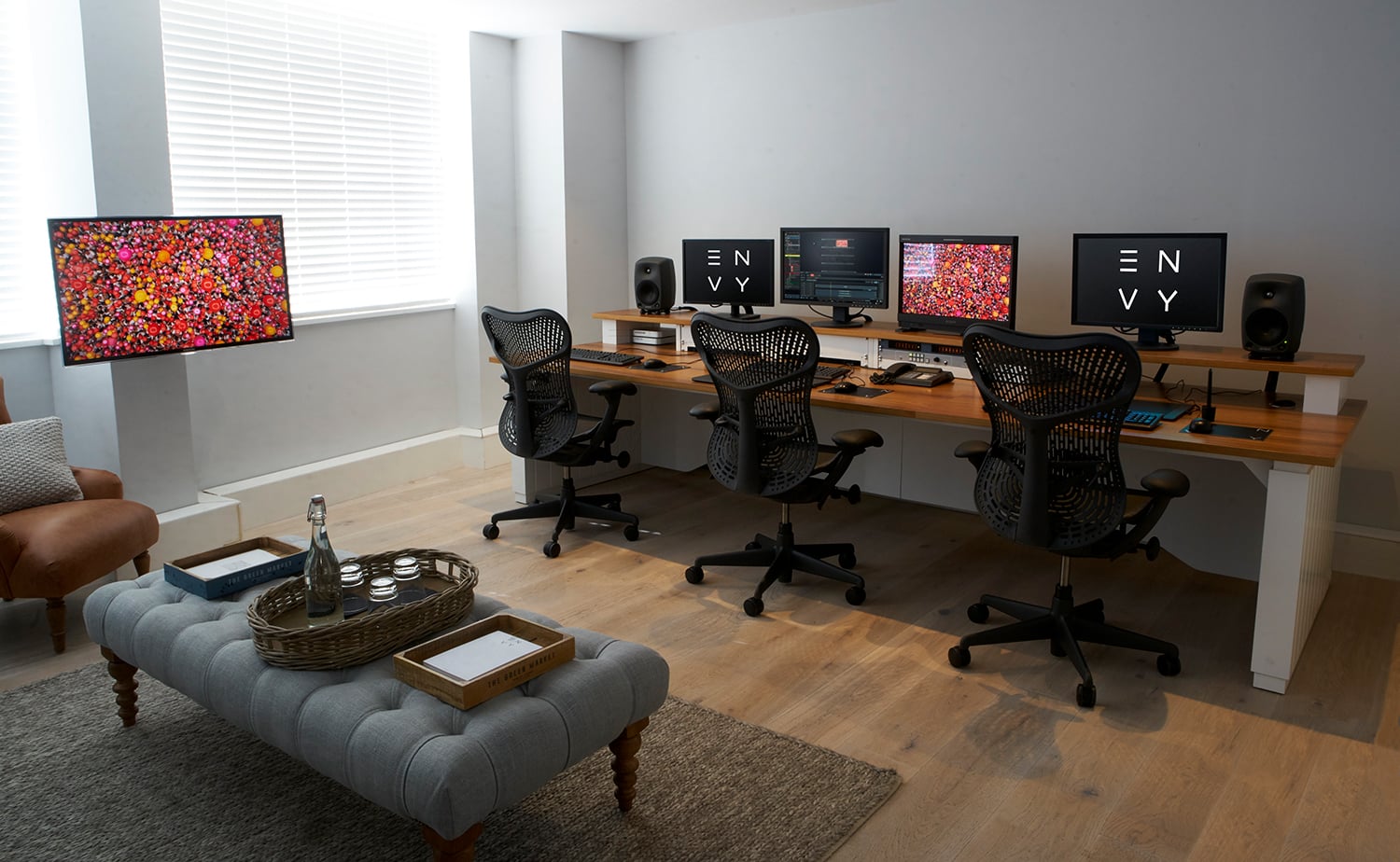
This is a story about a studio. One of the world’s leading visualisation firms, built on a reputation for innovation and the personality and values of its founder. It’s the story of how, when it came to rebranding and moving offices, the collaborative studio also fundamentally changed its approach.
When Hayes Davidson enlisted Escape Technology to refresh its creative workstations, the question of what to buy was shaped by decisions about who the studio was and how it wanted to work.
“This has been a bit of a journey for us in finding an identity as a studio, one that celebrates the talented people and specialist skills that make up Hayes Davidson as it is today,” says Neil Hughes, Joint Managing Partner and Commercial Director at Hayes Davidson. “We’re not volume output – we’re very much about thoughts and ideas. We’ve always focused the team on learning and expanding their creative horizons. We love people who want to try stuff.”
All change at Paddington
For nearly three decades, Hayes Davidson was synonymous with a Paddington address and with its founder, Alan Davidson. The studio became employee-owned in 2015, before Davidson sadly passed away in 2018. “That was a big change,” says Hughes.
“Our rebrand in 2021 was really our first identity shift,” he adds. “We wanted to really tell the wider market who we are, what we do.”
If you walked into Hayes Davidson’s Paddington studio, you’d have been greeted by a 30-year legacy. In terms of technology, however, that meant big workstations for everyone, limited networking, local storage, and the server used only for very large, layered files.
“Pre-Covid, we would have individual workstations under our desks,” says Art Director and Head of Planning, Graham McCormick. “We had a render farm of maybe 12 to 15 extra machines just sitting there, sometimes doing nothing. The network speeds weren’t that reliable, and the wiring was showing its age.”
“When Covid hit, we invested in laptops for every member of the team and started using VPN to access our workstations. That unlocked the thought that we no longer needed our workstations on site; even in the studio, we were remoting in.”
This tied into a conversation about a new home for the studio. The decision was made to move to smaller, more modern premises near London Bridge, replace the server room with off-site data storage, and upgrade the on-site workstation and render farm fleet.
Crossing the river
“The data centre decision would also influence what hardware we would buy,” says Hughes. For the latter, Hayes Davidson turned to specialist reseller Escape Technology.
Hughes has known and worked with Escape since before he joined the studio, 18 years ago. “Anything technical, whenever we’re thinking of something different, and I just don’t know where to start, I just go and have a chat with Escape,” he says. “I’m not always saying give me the solution, it’s just to give me a good steer one way or the other.”
Hughes values the type of technical advice Escape offers. “If you ever ask Lee [Danskin, CTO] a question about technology, the guy is incredible,” he says. “It really has to do with pipeline: all about machines, about output, what goes on in between, what’s the quickest, most efficient way. That’s what they’re always tuned in to.”
Hughes is equally complimentary about Jason Jenner, Escape's Commercial Director: "From a sales level, his detail is very, very good. It’s quite forensic, rather than being ‘have one of those, it looks nice.’ They really listen to what you’re asking and flex and change with whatever you’re saying.”
With the data centre concept settled, McCormick says the Escape team was able to advise on the combination that best suited the studio.
“Where Escape’s unique power comes from is their knowledge of the visual communication industry, from VFX through to what we do,” says McCormick. “They have an understanding of how we’re trying to use machines, the software we’re using, and the requirements those things demand."
“We’re using Autodesk products, things like 3ds Max and AutoCAD, as well as rendering software,” he explains. “We run a lot of CPU-heavy, RAM-heavy processes.”
The firm specified and delivered a fleet of HP Z4r rack-mounted workstations, configured to offer the right balance of CPU, RAM and GPU resources for Hayes Davidson’s software stack and project types.
“I don’t need to be sitting looking up graphic processing speeds and CPU temperatures, I just need it to work,” says McCormick. “What Escape were able to really help us with was drilling down and making those numbers make sense.”
The standard fleet was brought to a uniform spec. The former model of workstation towers scattered around the studio under every desk gave way to a flexible-pool concept, where workstation allocation follows project needs rather than fixed ownership. On-site artists can precisely access the capabilities they require, and remote team members can connect from anywhere.
Alongside the standard HP fleet, Hayes Davidson added a small number of high-end SuperMicro workstations. As Hughes explains, these can be partitioned into multiple high-spec virtual instances for the most demanding projects. “You can actually divide them so you can have four machines which are still individually better than the old setup,” says Hughes. “That gives us real flexibility at the high end, because you want to do your flexing at the top end, not the bottom.”
“Not everybody needs that [much power] all the time,” agrees McCormick. “But depending on the project and its power requirements, you might have to move to a more powerful machine. Having that flexibility in power usage has been a real change.”
It wasn’t without friction: “With the type of work we do, it can be quite individual,” he observes. “The way people set their workspaces, the plugins they might use. Moving isn’t without its pinch points. But it made the studio more flexible and efficient, with the team able to use powerful machines when the work demands it.”
Working closely with Hayes Davidson’s team, Escape helped redesign the render strategy so that the artists’ own workstations now double up as part of an overnight render farm. The old standalone farm of 12 to 15 machines has been scaled back as a result, with workstations themselves taking on the load once the studio closes for the day.
Throughout, Escape acted as a specialist adviser, aligning hardware, workflow and commercial structure rather than simply supplying boxes. This included a suggestion to move to a vendor-supplied remote access solution to replace the cloud-delivered software service Parsec.
“They were recommending it and giving us examples of why they thought it was the right solution, but they didn’t push it,” says McCormick. “They accepted that we would trial it – if we liked it, we liked it. It wasn’t a contentious discussion.”
Running the numbers
Escape also introduced Hughes to a new leasing model through a finance partner, allowing the studio to spread costs monthly, keep pace with technology refresh cycles, and return the hardware at the end of the term.
“Typically, what we would previously do is replace systems every few years. But changing market conditions meant it was worth exploring other options, and financing through Escape was the best decision for the business.
“Escape doesn’t do any of the financing, but Jason’s knowledge around that was really helpful,” adds Hughes. “There are different types of financing, and through this discussion, we found what we wanted.
“In the end, we went with a residual value model. In three years, we will hand back all the kit; probably three months in advance of the end, we’ll start talking to Escape and look for a seamless changeover.
Building momentum
Hayes Davidson has begun another new chapter. Having worked alongside New York's leading architects, developers, and designers for more than two decades, the studio has expanded its presence with the opening of a New York studio. "A lot of our work is in New York and the States. We just feel this is the right time to have a more permanent connection with our clients there," says Hughes.
And Hughes says Escape is likely to continue being part of the supply landscape.
“I view every supplier or consultant as part of a team. And I want them to see themselves as part of the team because they’re providing something which is great,” he adds. “If they can’t provide something great, we'll look for someone else. If you accept mediocrity, you start to bring your own standards down.”
.svg)


.jpg)
We'd love to hear from you, why not speak to us today...
Whether you're a small studio or a global company we can help you.
.avif)


